Howell & Gibbs · Co-founder
SendTax filer experience
Context
Co-founder & Design Principal · 2026
Studio: Howell & Gibbs, co-founded with engineer Liam Howell
Services: Product strategy · UX design · Design systems · Front-end development · User research
Product: A document-collaboration platform for tax preparers and their clients · Pre-launch, in private Early Access
Companion study: SendTax Trust Center
Illustrations: Vivid by Get Illustrations on Unsplash
Typefaces: Space Grotesk and Instrument Sans
Component library: Built in Storybook
- Turned the "game of telephone" of tax-document collection into a guided experience that tells filers exactly what to upload, reads each document, and fills in the checklist on its own
- Reworked the marketing homepage's layout, palette, and navigation, and refined the animated product demo Liam built for it
- Built the research loop that runs the private Early Access Program, and the shared design system that spans six front-end apps
My contributions
UX & front-end
Designed and built the filer experience: the guided "exactly what to upload" flow, the document-reading and checklist states, a checklist-completion celebratory moment, navigation, upload flows, and custom iconography.
Product strategy
Co-defined the product with my engineering co-founder, and shaped the core promise: replace the back-and-forth of document collection with a guided flow that does the guessing for the filer.
Design system
Built and maintain the shared design system across six front-end apps, with shared UI and Tailwind-config packages and a Storybook library that doubles as each component's spec and visual-regression test.
Research & Early Access
Built the engine for the private Early Access Program: replaced an off-the-shelf survey tool with a custom in-product survey system, designed the weekly research rhythm and emails, and built the admin tooling to manage testers and read results.
Summary of work
Tax documents are some of the most sensitive data a person owns: W-2s, government IDs, K-1s, the whole financial picture. And yet the way most people get those documents to their tax preparer is a mess. Emails fly back and forth, files get lost in threads, and the client asks "did you get my W-2?" for the third time while the pro drowns in admin work instead of doing the work they're good at.
- 1. This year's return
- • Basically done besides a few questions ✅
- • Any charitable contributions to add? Receipts uploaded 3/12 ✅
- • Other forms besides what's provided — brokerage 1099s? Still tracking these down
- 2. Prior-year return
- • Upload source documents:
- ◦ W-2 (possibly two issued?) Working on it 4/4
- ◦ Brokerage 1099 + cost-basis supplement ✅
- • State account — can you log in and confirm status? Confirmed, nothing owed
- 3. Going forward
- • Once the prior years are cleared up, we'll focus on planning ✅
Uploaded the brokerage docs to the portal ✅
Logged in and confirmed — nothing owed for that year.
@John please take a look and tell me what else you need.
Balance paid. All set 🎉
SendTax replaces that with a single, secure place where a tax pro and their client collaborate. It guides the filer through what they need to share and keeps both sides in sync as the checklist comes together.
I co-founded Howell & Gibbs, the studio building SendTax, with engineer Liam Howell. I own design across the product, and build front-end on the marketing site, the filer experience, the admin console, and our shared component library.
Process
From the game of telephone to a guided checklist
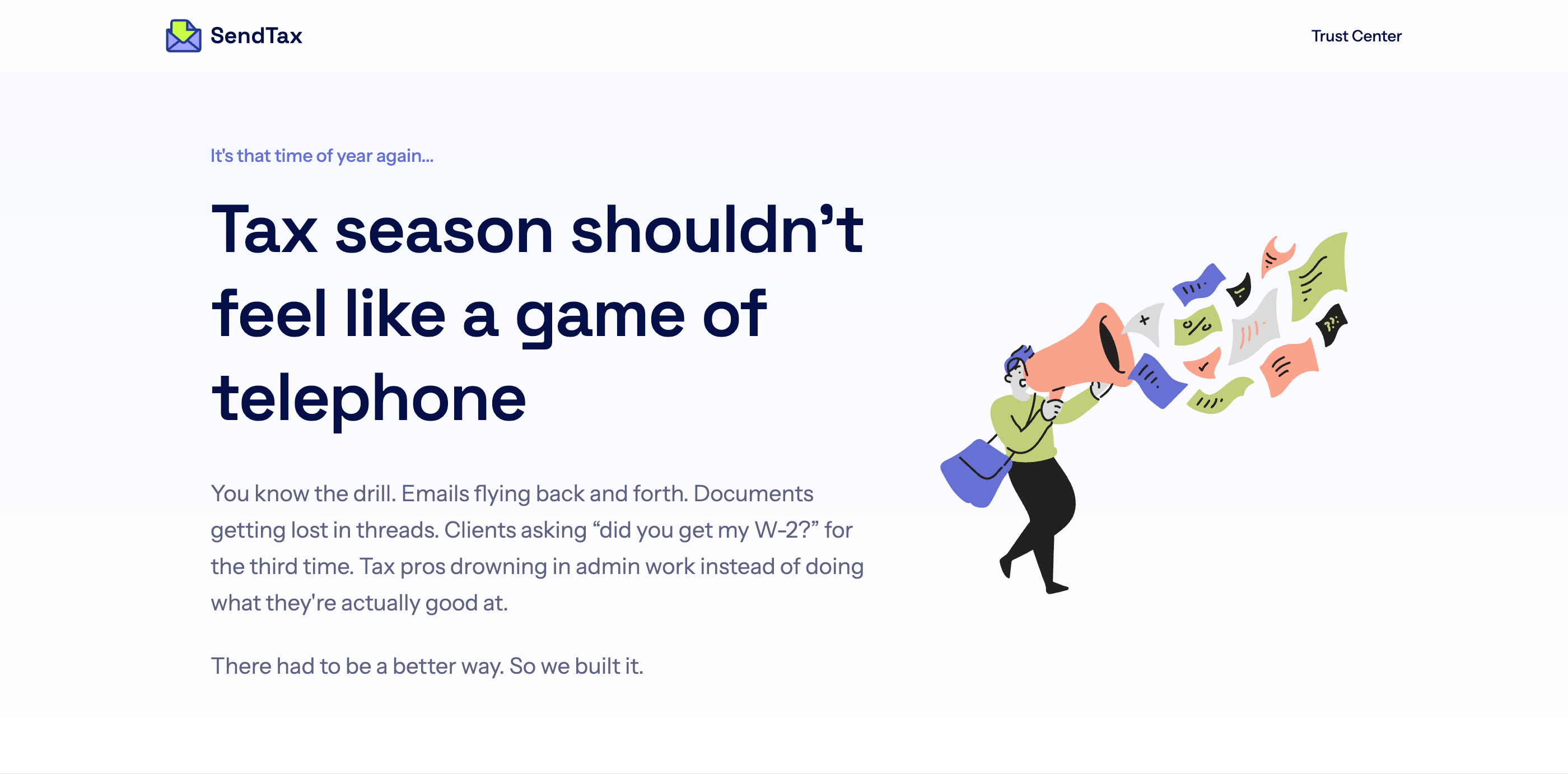
The marketing site names the problem in plain terms: tax season shouldn't feel like a game of telephone. I reworked the homepage's layout, palette, and navigation around that promise, and refined the details of the animated product demo Liam built for it. The new homepage also moves the security story up front, replacing a single "bank-level security" line with a section a visitor can actually read and verify.
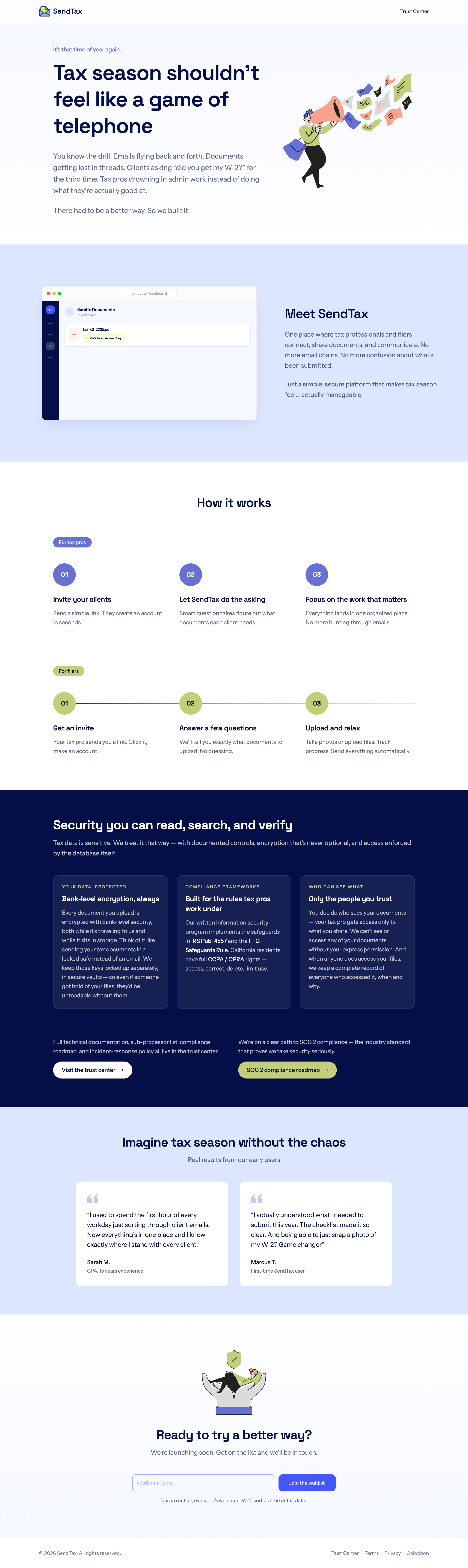
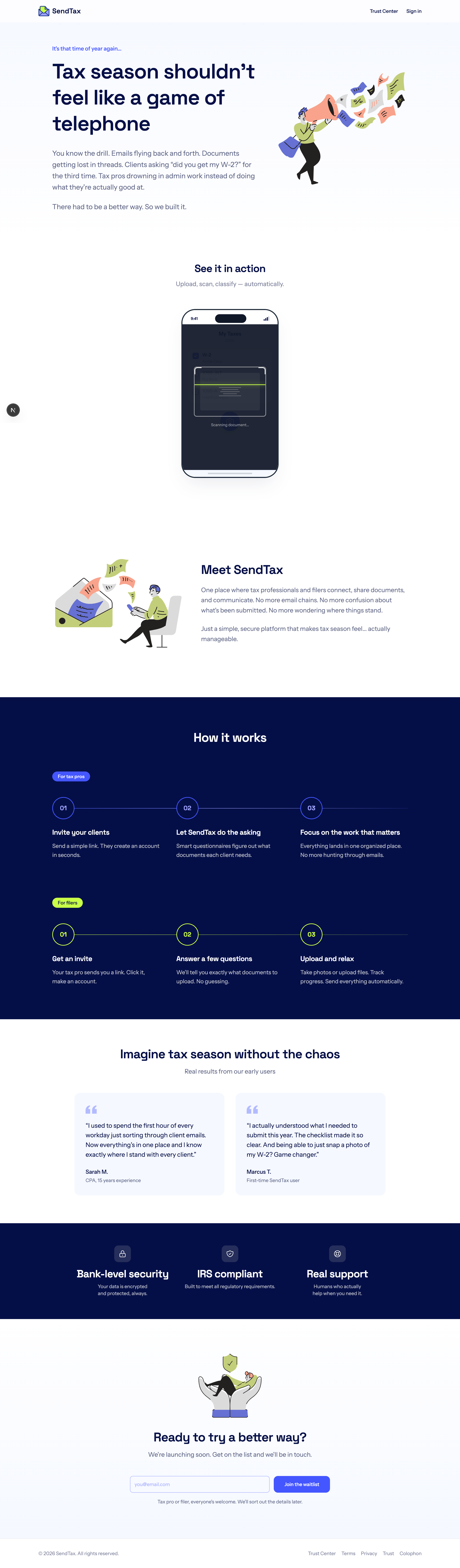
Inside the product, that promise becomes a guided flow. SendTax builds an accurate picture of the filer's situation from their previous year's return and a few simple questions, then tells them exactly which documents to upload, reads each one as it lands, and fills in the checklist on its own. When everything is in, a celebratory moment closes the loop: a checklist-completion banner that gives the filer a clear, calm "you're done" instead of leaving them wondering. It's a small, reusable UI component, shared across the apps.
 SendTax
Your 2025 tax documents
Building the research loop for Early Access
SendTax is in a private Early Access Program, and an early-access program is only as good as the feedback it generates. So I built the engine for it. Rather than bolt on an off-the-shelf survey tool, I built a custom in-product survey system: survey assignment, a native survey player, direct submission, and per-question stats, so research lives where the users already are and the data comes back clean.
How did uploading your documents feel?
Around that I designed the program's weekly rhythm: getting-started guidance, a predictable cadence of prompts, and emails that keep testers engaged without nagging. I also built the admin tooling Liam and I use to run it: managing testers, with editable details and safe deletion of testers who have no research data attached, plus editing and soft-archiving surveys so we never lose past responses.
SendTaxSurveys
Surveys soft-archive instead of deleting, so past responses are never lost.
One system across six apps
Underpinning all of it is a shared design system. SendTax is a pnpm and Turbo monorepo with six front-end apps (filer web, tax-pro web, admin, marketing, mobile, and an internal labeler) plus shared UI and Tailwind-config packages. Working in the same codebase as my co-founder means design decisions ship as components, not redlines. The shared UI lives in Storybook, which doubles as each component's spec and its visual-regression test, so a change to a button or a checklist row is reviewed in isolation before it reaches any app.
Outcomes & impact
SendTax is pre-launch, in a private Early Access Program with friends-and-family testers, ahead of a public release. On the filer and product side, shipped to date:
- A reworked marketing site built around the "no more game of telephone" promise, with an animated product demo and a colophon crediting the studio.
- Product UX across the filer and pro apps: the guided upload experience, document-reading and checklist states, navigation, and a reusable checklist-completion moment.
- The Early Access research engine: a custom in-product survey system, a weekly research rhythm, and the admin tooling to run the program.
- A shared design system and component library spanning six apps, documented and regression-tested in Storybook.
Learnings
Co-founding means designing in the material, not on top of it. Working in the same monorepo as my engineering co-founder collapses the distance between a design decision and a shipped reality; I edit the same components that go to production instead of handing off redlines. The flip side is that process becomes a design problem too. Liam and I had to build the systems that let two people move fast without breaking things: conventions and tooling that keep our changes from colliding in the codebase, security checks that run automatically on every commit so nothing sensitive slips through, and a standing habit of both of us reviewing anything critical before it ships. Those systems started as a way to protect this stage, and they are the processes we will scale on as the team grows.
Reducing anxiety is a feature. Taxes are stressful, and the people using SendTax are often not the ones who enjoy this. The wins came from calm defaults: telling people exactly what to upload instead of handing them a blank box, reading their documents for them, and closing the loop with a clear "you're done" rather than a silent success. None of that is flashy, and all of it lowers the cost of getting started.